I originally wrote this piece for the FUCKIN’ RECORD REVIEWS print fanzine that’s yet to come out (though as I’m sure you know, they’re very much alive otherwise). The editors there gave it a snazzy French title, which I liked. This “data” has a bit of a shelf life – apps and music consumption being a bit of a moving target – so I thought I’d post the piece here.
Au
Courant in the Car
Or, modern man’s musical sublimation to the
machine
by Jay Hinman
It says more about me than
I’d like it to – but I’ll come clean and admit that I’ve fully succumbed to a
nearly 100% digital lifestyle when it comes to the consumption of music (the
occasional 45 or LP purchase notwithstanding – as these are purchased for
ultimate digitization purposes). This really doesn’t even involve compact discs
any longer. Everything I listen to, it’s on my phone. Yeah, my telephone. Who among
us would have imagined such an abomination, even a couple of years ago? I
listen to upwards of an hour or two of music every day, and most often more.
Much of this is done in the car, as I’m one of the unfortunate cogs in the
great, grinding corporate deathburger who commutes a great distance to work.
I’ve outfitted my chariot with an auxiliary hook-up that lets me plop the HTC
One smartphone or my iPod Touch into a cradle, and then run whatever comes out
of it through my car’s speakers. Perhaps you’ve seen, or have yourself
experienced, such a get-up. Not to put too fine a point on it, but it has been
culturally life-changing, and totally has opened me up to entirely new ways of
getting clued in about radical new sounds.
I thought I’d pull together the music apps that I whole- or at least halfheartedly
recommend for you. You’ll probably heard of most of ‘em. Granted, this is
mostly an Android conversation, so I apologize in advance to any lingering iPhone
users out there who haven’t jumped ship like I did a couple years ago – though
I’m pretty sure most of these are available for you holdouts, too. If you’re
still rocking a StarTac or a Razr, I’m sorry, but I do admire your stance on
many levels.
SPOTIFY – Perhaps no application or
service has so upended the way music is consumed and delivered as Spotify has.
Some might say for ill – perhaps musicians themselves, say – and I’m
certainly sympathetic to the argument. That said, wearing my pure consumer hat,
I happily pay them ten bucks a month to listen to the app, ad-free, on mobile –
in fact, I have never actually experienced Spotify as a “free”
customer, since I rarely use a PC to listen to music. The catalogs they pull
from run incredibly deep, and often include brand-new independent and deeply
underground 45s and LPs the week they’re released. Not everyone’s on there, of
course, but seems like 9 out of 10 things I hear about and want to try are
easily found within the app, especially the weirdly experimental music often
written about in publications like The Wire.
The mobile app lets you subscribers store stuff for offline listening, kinda
like you “own” it – which makes it easy to listen to in poor coverage,
or when you’re off the wireless grid entirely. And despite aforementioned
grumblings from a few artists about meager paychecks, I’m chastened to know
that every song I stream deposits at least a couple hundredths of cents in the
musicians’ bank accounts. Totally essential app for the modern music doofus,
and I have to say it’s getting better every update.
FLICKTUNES (now called CARTUNES) – This iTunes alternative
could better be classified as a “public safety” app, as it’s probably
kept me from plowing my vehicle into those in front of and on the sides of me
on far too many occasions. You know how when you’re playing a song or even a
downloaded podcast or radio show in iTunes, you’re only able to
“scroll” though a song – but not advance it 30 seconds forward or
backward? I know – horrifically lame, right? (they call that bar the
“scrubber”, by the way. Thought you’d like to know that). That doesn’t work
when you’re driving, even when your iPhone or iPod is mounted right in front of
you there on the air vents. FlickTunes lets me use a “two-finger
swipe” to easily advance 30 seconds in any song, which works especially
well when I’m listening to a radio show and I don’t wanna hear a particular
song or songs. There are other cool features as well, but that one in
particular is a lifeline both for me and the people who drive near me.
8TRACKS – I’ve been singing the
praises of this app for years in my various online blather forums, and my
enthusiasm hasn’t diminished in the slightest. 8Tracks is user-programmed and
-curated mix tapes, effectively. It has attracted some incredibly knowledgeable
experts across all sorts of sub-genres: 60s french pop; KBD-style punk;
pre-WWII Latin music; C86 pop; female-created electronic music of the 60s; and
loads of indie bands of every stripe. Wind it up and let it go. It’s the next
evolution of radio, if you think about it, and about the only downside is the
inability to skip more than 5 songs in a row – which has nothing to do with
8Tracks, and everything to do with
keeping things kosher with the labels and publishing houses. Some curators I
recommend over there are Isitanart, SpaceBunnySounds, the13thTrack, fuckinrecordreviews
himself, ohanaorsomething, urbankill,
Wub-Fur Internet Radio and hey, me.
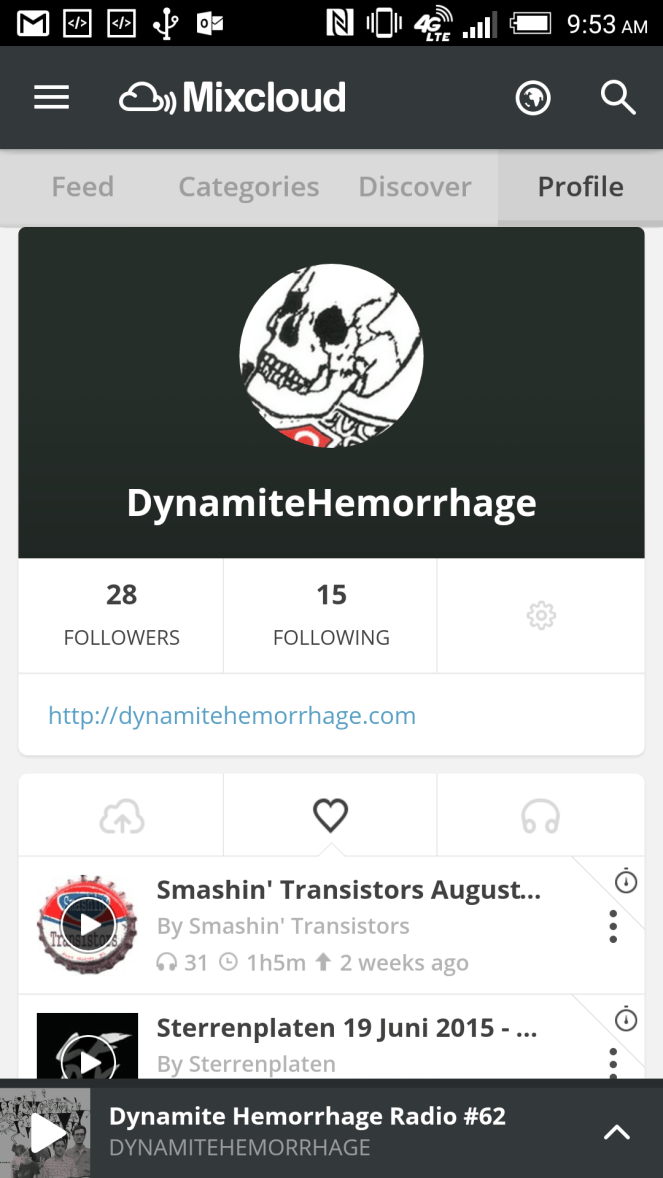
I’m at DynamiteHemorrhage, and I
have a page full of mixes for the streaming-minded. The whole thing works
just as well, if not better, on your laptop, and there’s a cheapo premium
version if you don’t want to see ads, which I don’t.
SOUNDCLOUD – At first it seemed like
this site was all about people uploading field recordings of bird sounds &
such, but music fiends being music fiends, it morphed into a hosting site for
mp3 files, and now it’s become one of premier locales for underground music
from the independent and/or totally unaffiliated. The difference between mp3
blogs of 2015 and those of, say, 2008, is that the latter truly gave away mp3s
as downloads – hey, I did it myself. Today, almost everyone posts them on
Soundcloud, which makes artists happy, and makes it more difficult for you to
“acquire” a track without paying for it. (Yes, I certainly know about
the workarounds, god love ‘em). It also means that, if you still follow what
few music blogs exist, you need to click the little heart icon on the song
that’s been put onto Soundcloud, which then saves that song for you to listen
to later. I’m always creating these playlists of songs I read about, then
listening later on SoundCloud. The app still needs to evolve a bit, but it’s
very useful & seems to be the place where mp3 uploads of all kinds have
settled the past couple of years.
BANDCAMP – This one comes with
some major caveats. Bandcamp became the platform of choice for independent
artists to store their recorded music over the past 24-36 months, displacing
MySpace entirely. It’s 1,000 times better than MySpace ever was, which
obviously isn’t saying a goddamn thing. There used to be something cool called
Bandcamper, an app that applied a “presentation layer” over the
broader Bandcamp universe, but it had some gaping holes (like maddening search
functionality) – and it seems to have been hounded out of the app stores
entirely. Along came Bandcamp’s own app a little over year ago, and it’s
beautiful. If you’ve bought something on Bandcamp – and who hasn’t – it’s
available in full for streaming from the app with a touch of a button. It’s
cloud-based storage for everything you’ve ever purchased there, like, ever. That said, if you downloaded
something for free from Bandcamp, or even if you willingly gave a few sawbucks
to a “name your price” album or 45, it won’t show up here. Why not? Hell if I know. There are also discovery features where
you can find out what other people are buying, and then stream 1 meager song from each of their albums
(that’s all that’s allowed) – but I do miss Bandcamper’s smorgasbord of music compiled
from the entire Bandcamp universe. (Note:
it looks like they may have sorta addressed this in a recent update, so stream
away…!)
MIXCLOUD – A total up & comer that started really delivering just the past
few months. Initially it was much like 8Tracks: a place to upload your curated
modern mix tape, just not nearly as good. Recently it’s found a new niche as
the place where “disk jockeys” from the world’s terrestrial and internet radio
stations and from laptop-based phony
radio shows upload their recently-finished programs. This is a profoundly
important development if you’re not already a leading expert on every known
corner of the underground music universe, and lean heavily on clued-in curators
the way I do. Given the newfound ubiquitous matching of cool radio sets and
Mixcloud, I’m able to subscribe to sublimely righteous radio shows emanating
from Belgium to Bellingham, and these shows simply pop up in my feed every
week. It beats setting an alert to listen to the thing in real-time (old school!) by well more than a mile.
iCRATES – This really isn’t a
car app and is therefore a bit of an outlier to the broader article, but it’s a
terrific iPod/iPhone app. iCrates is for those of us/you who still buy records
and CDs, and who would like an aggregated peek into where you can find a
particular piece on vinyl or a given disc. It looks into the Discogs, eBay
and Amazon databases and presents you with who’s selling what, where. Far be it
for me to do anything to hurt traditional record stores, which I love, but this
is their worst nightmare unless they’re hot on the draw and are presciently selling
their wares in these forums. Used vinyl prices in stores can be easily undercut
with a quick search on iCrates for that same vinyl at a far better price. Capitalist
porker? Guilty as charged. Besides that, it’s totally fun to mess around with,
as it has the amazing Discogs.com database, with photos and sleeve scans, right
there at your proverbial fingertips.
WFMU, WMUA, KFJC, RADIO
VALENCIA, HOLLOW EARTH RADIO etc. – Finally, there are the many
college/pirate radio station apps. I recognize that there are aggregators like
Tune-In out there that work really well, but I personally prefer an easy-to-see
icon on my device that I can punch whilst driving, rather than the extra three
clicks it takes to find what I want there. That could be the different between
a mellow drive home and Hamburger Highway.
The best radio station
apps start playing immediately upon launch, and provide song identification in
big letters on the screen. WFMU’s app goes those one better, and not only
streams all of their podcasts and show archives, but even lets you
“favorite” individual songs so you can check up on them later (or buy
them on iTunes if they’re available there right now). Absolutely the best radio
station app, from a station that’s always one step ahead of everyone else. I
personally also enjoy the quasi-legit pirate stations Hollow Earth Radio,
BFF.FM and Radio Valencia, along with college stations KFJC, WMUA,
KUSF IN EXILE, KEXP and KDVS. This is where time and patience
finally meet the limits of my commute – we’ve arrived at home, and seriously,
there are no other radio stations I’ve even got the time to investigate on this drive – so we’ll stick with these old
favorites.
Now some folks have
informed me that people even “listen” to music on “YouTube”. YouTube! As if. What’s wrong with you
kids? Keep your eyes on the goddamn road, and stop watching music videos – I’m futzing
with my smartphone over here.




 AGONY SHORTHAND