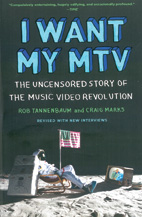
My sister and I were captured and shackled children of cable television, circa 1978-83. We watched a lot of TV. I’ve written about the G Channel before,and I’d have written a post about watching Australian Rules Football anddivision 3 college basketball on ESPN in 1979, when it first debuted, if I hadn’t disliked the ESPN oral history book so much and stopped reading it midway through. The biggest event in our suburban world, however, was the debut of MTV in the summer of 1981. I was 13 years old, my sister was 10. We were both pretty music-crazy, with me a budding new waver and punk, accustomed to looking for marginally different culture in any crevice wherever I could find it. We got the channel from Day One, and as the fun and funny MTV oral history “I WANT MY MTV” makes clear, we were one of the only cable systems that had its 24-hour music videos from launch day onward. We were “lucky”, if that’s what you want to call it.
Before I go any further, I’ll say for the record that reading this book was a “trifle” that made for some light written entertainment between my many books on 20th century slaughter and failed cities. I stopped watching MTV around the time of my 16th birthday. Yet it would be fatuous to ignore how much time I spent with the channel as a young teen, and wrong-headed to discount how influential it was at molding the mainstream music culture to its optics-friendly way of thinking (and spending). The night before MTV’s debut, our cable system, San Jose’s Gill Cable, did a one-hour host-free preview of the upcoming channel in which they played videos. We were so excited, we invited some friends from across the street over, and watched visual representations of songs by Pat Benatar, The Buggles, Tenpole Tudor, REO Speedwagon and others. If MTV hadn’t debuted at midnight that night, we’d have been up to watch it (as it was, the day they went live was the day of the Charles & Diana Royal Wedding, as I recall – and that was on every other channel).
From that point forward, we must have watched 2-4 hours a day, every day, for at least two years. MTV didn’t have much inventory – they’d started this channel in the hope that it might take off, and record companies would then makethe inventory for them, which is exactly what happened. Yet in the beginning it was a lot of weirdo new wave bands and long-tail rockers. I made my sister a CD-R a few years back of all the early MTV bands that we’d barely heard or even heard of since 1981-82: Blotto, Classix Nouveau, Bootcamp, Robert Palmer (“Looking for Clues” was played every 30 minutes), Split Enz, Adam and the Ants, Rupert Hine, The Shoes, April Wine, Ultravox and so on. Just look at this list. I truly must have seen each of these videos 100 times or more. We would play “video charades”, where we’d act them out. Totally obsessed. They played Kate Bush, whom I loved, and they even snuck in some Bauhaus here and there. And TONS of Pretenders and Phil Collins. Always with the Phil Collins.
A couple years later, when MTV really started to shift how record companies and artists defined themselves – and when the channel’s popularity exploded with the careers of Michael Jackson, Madonna and Prince – I’d self-righteously renounced it, and was instead deep into college radio and obscure record collecting. The book carries on from there, though, and takes you into the early 90s, and ends right when MTV as a music video channel ended – when they began running reality programming and realized that the music video era they’d created had peaked long ago and wasn’t sustainable as a business. Savvy move for sure – since no one created an alternative to fill the supposed gap.
Call it a guilty pleasure or whatever you want, but this oral history is well done and totally readable. A good oral history, well-assembled and edited, is hard to beat, and this is as kind to its subject matter as “Please Kill Me”, “Live From New York, An Uncensored History of Saturday Night Live” and “The Other Hollywood” were to theirs. I don’t know why the ESPN history was such a bust, since the two books were so similar in form – upstart cable channel that no one believed in scraps for funding, then scraps for programming, then proves all the haters wrong, gets rich, lives large. Tannenbaum and Marks gather interviews from across the MTV universe, from the business people who founded and funded it, to the VJs (surprisingly light on the Nina Blackwood and JJ Jackson, though) to the rock stars themselves.
The more sordid the tale, the more likely it makes this book. I often find drug- and booze-filled “I partied soooo hard”memoirs to be among the lamest of all genres, but thankfully this one doesn’t go too overboard with it the way, say,“Easy Riders, Raging Bulls” did. There are many people, bands and later MTV shows that I’ve heard of, but really know nothing about. I missed an entire 2nd and 3rd wave of MTV “VJ”/hosts, people like “Adam Curry” and “Karen Duffy” whom I can’t visually picture, and I believe I am the better for it. Likewise, even though I never saw supposedly seminal shows like “Remote Control”, “Club MTV" and "Yo MTV Raps”, the book is really good at painting a picture of American mass entertainment circa 1981-92 and even makes these stories compelling and interesting for jaded boorslike myself.
Of course, the music industry is filthy, disgusting and full of idiots. This book does nothing to dispel that truth. People who stand out for being pompous, ridiculous and full of it are the aforementioned Adam Curry; Abbey Konowitch; “Sebastian Bach”; and some of the toadies who helped found MTV, especially Les Garland. Some of the stories of how the industry, or how artists, interacted with MTV are great fun: Michael Jackson and his label insisting that MTV VJs had to call him "The King of Pop" on air at least twice a day; Nirvana terrifying MTV with their threat to debut their new song “Rape Me” at the 1992 video music awards, and then playing the first few bars of it before launching into a different song; the late 80s female VJ who was fired for wearing shorts onto the set without shaving her legs; and pretty much anything having to do with Van Halen and their more-more-more approach to video making.
See, even you wanna read this book now, don’t you?
 AGONY SHORTHAND